Application requirements
I/O density, cycle time, motion or process requirements, field distances and maintenance needs are assessed together. This defines the requirements of the working system, not just individual products.
This machine automation application uses HMI, PLC and field signals to address field control, reliable communication and maintainable commissioning.
I/O density, cycle time, motion or process requirements, field distances and maintenance needs are assessed together. This defines the requirements of the working system, not just individual products.
The proposed architecture combines HMI, PLC and field signals with the machine’s existing control infrastructure and communication protocols. Final product and module selection depends on site requirements.
ProControl can adapt the solution to local project requirements in Türkiye, from site assessment, I/O planning and protocol selection to panel layout, commissioning and after-sales support.
The technical workflow and visual information from the manufacturer are presented below.
Global logistics and high-end industrial equipment exporting demand ultra-reliable, heavy-duty protective packaging. Steel-banded wooden boxes have become the established packaging standard for international freight due to their robust nail-free structures, rapid assembly/disassembly cycles, and ecological sustainability. Within this manufacturing chain, the automated wooden buckle machine executes the critical final structural assembly, swaging metal steel belts directly into the wood substrate to form a highly rigid, integrated protective housing. The control automation must handle precise high-frequency digital I/O, manage sequential hydraulic press dwelling timing, and calculate real-time spacing metrics to eliminate mechanical jamming and workpiece scratching.
| Hardware | Model | Specific Role within the Architecture |
|---|---|---|
| Logic & Control Layer | Samkoon FAs-Series PLC | Coordinates high-speed binary instruction loops, dynamic hydraulic cylinder timing gates, and encoder position sensing interrupts. |
| I/O Expansion Layer | Samkoon S-E8X8T Module | Expands dedicated discrete high-frequency channels to interface with multi-point material detection arrays and solenoid valves. |
| Operator Interface Layer | Samkoon SK-070ME HMI | 7-inch industrial IP65 touchscreen operating on a non-OS micro-kernel. Manages A/B buckle profile recipe storage, math-driven spacing formula entry, and operational logs. |
To prevent programmatic overlaps or mechanical boundaries breach, the core logic continuously evaluates the following hardware safety rung:
(Number of Buckles - 1) × Fixed Interval Distance + 2 × Margin ≤ Actual Board Length
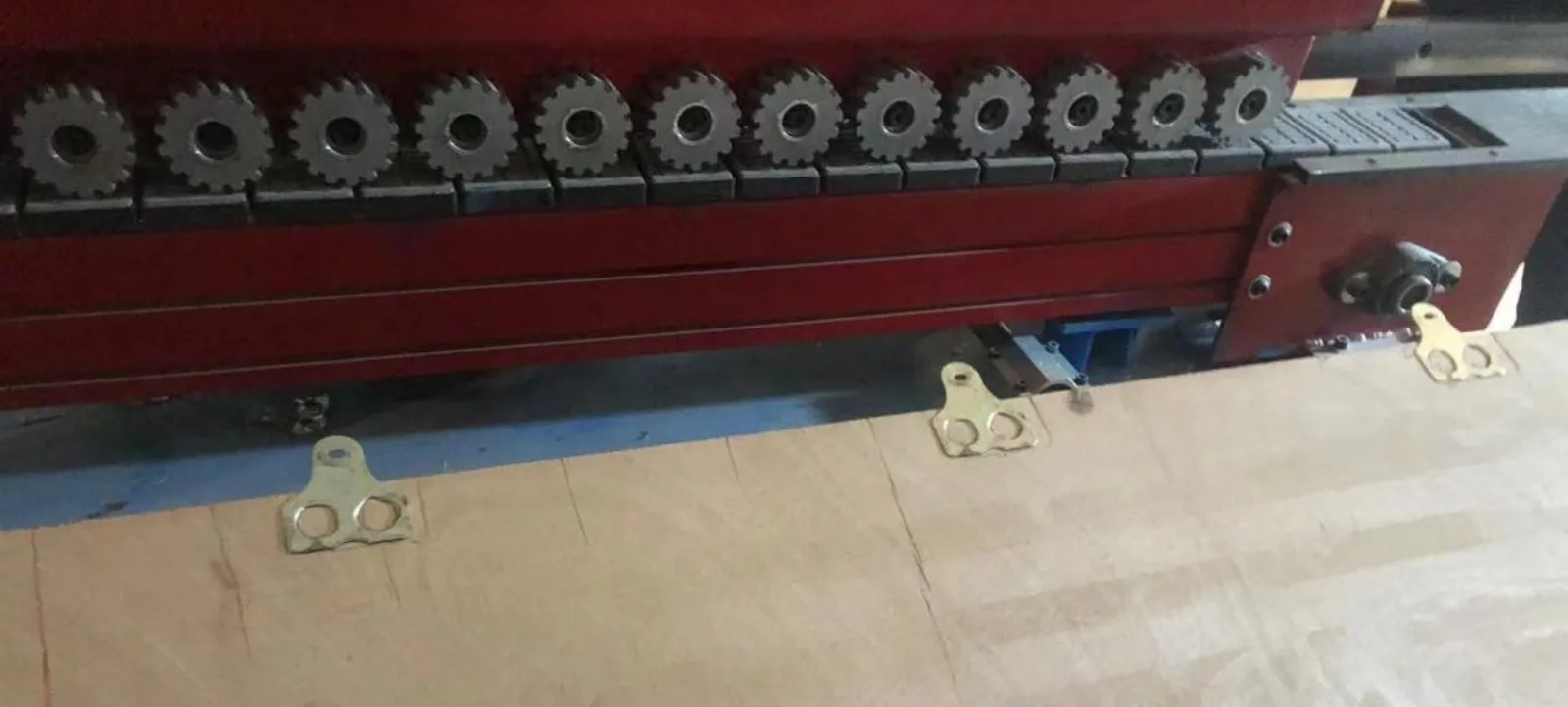
Actual workshop field installation and software deployment. The field telemetry captures the steel belt crimping tool array processing raw wood layers, maintaining automated step-and-repeat positioning routines, sub-millimeter interval consistency, and clean, nail-free edge finishing profiles without structural deformation.