Application requirements
I/O density, cycle time, motion or process requirements, field distances and maintenance needs are assessed together. This defines the requirements of the working system, not just individual products.
This automotive application uses Integrated remote I/O to address field control, reliable communication and maintainable commissioning.

I/O density, cycle time, motion or process requirements, field distances and maintenance needs are assessed together. This defines the requirements of the working system, not just individual products.
The proposed architecture combines Integrated remote I/O with the machine’s existing control infrastructure and communication protocols. Final product and module selection depends on site requirements.
ProControl can adapt the solution to local project requirements in Türkiye, from site assessment, I/O planning and protocol selection to panel layout, commissioning and after-sales support.
The technical workflow and visual information from the manufacturer are presented below.
Automotive Intermediate Shaft Bearing Tolerance Inspection Equipment precisely locates bearing installation tolerance. Its high-cycle and high-precision nature demands extreme stability in signal acquisition. The integration of Remote I/O simplifies wiring complexity, enhances signal transmission efficiency, and reduces maintenance difficulty through centralized control, ensuring stable inspection processes.
Products used in this case: Solidot PN4-1616B , PN4-0032B , PN4-0016B

Workflow: Workpiece Loading → Claw Positioning → Tolerance Inspection → Sorting & Unloading
【Workpiece Loading】
Robots transfer intermediate shafts to inspection stations. Photoelectric sensors trigger positioning signals to initiate clamping.
【Claw Positioning】
Pneumatic claws provide real-time feedback via magnetic switches, with proximity switches calibrating shaft datum positions.
【Tolerance Inspection】
Servo mechanisms rotate workpieces. Laser displacement sensors scan bearing seat contours while photoelectric signals synchronously acquire dynamic data for real-time tolerance zone comparison.
【Sorting & Unloading】
PLC controls sorting based on results. Out-of-tolerance parts trigger alarms and automatic rejection.
A PROFINET network with Siemens S7-1200 PLC as master controller deploys I/O points near claws, inspection stations, and servos. Solidot integrated I/O modules are proximally installed:
PN4-1616B (16DI/16DO):
PN4-0032B (32DO):
PN4-0016B (16DO):
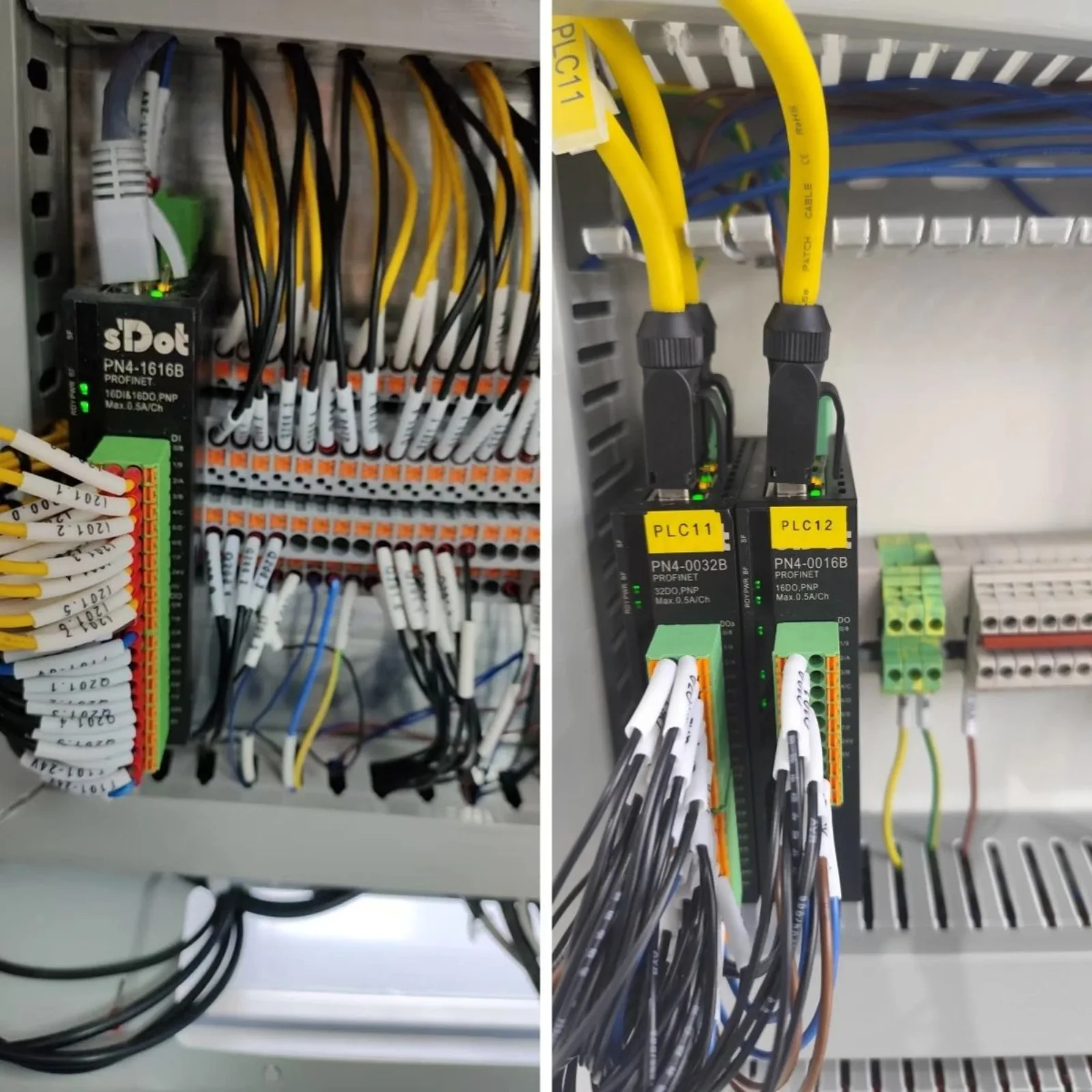
Replacing Siemens local I/O modules with Solidot PROFINET integrated I/O eliminated control cabinet congestion and long cable runs. Proximal deployment: ✓ 30% reduction in cabling ✓ Maintenance time decreased by 40% ✓ Signal stability improved to ±0.1%