Application requirements
I/O density, cycle time, motion or process requirements, field distances and maintenance needs are assessed together. This defines the requirements of the working system, not just individual products.
This electronics manufacturing application uses Protocol gateway and field communication to address field control, reliable communication and maintainable commissioning.
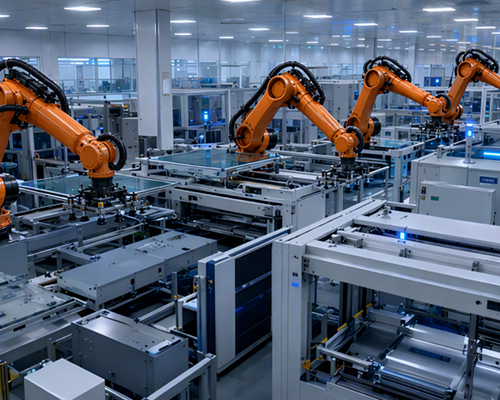
I/O density, cycle time, motion or process requirements, field distances and maintenance needs are assessed together. This defines the requirements of the working system, not just individual products.
The proposed architecture combines Protocol gateway and field communication with the machine’s existing control infrastructure and communication protocols. Final product and module selection depends on site requirements.
ProControl can adapt the solution to local project requirements in Türkiye, from site assessment, I/O planning and protocol selection to panel layout, commissioning and after-sales support.
The technical workflow and visual information from the manufacturer are presented below.
In the precision handling section of TFT-LCD production lines at LCD panel manufacturers, it is common for robots and PLCs to belong to different bus protocol systems. The data mapping and real-time performance between the two systems directly affect the collaborative accuracy and operational stability of the production line. This case study takes this production line as the object, demonstrating the application practice of Solidot's slave protocol conversion gateway module in heterogeneous protocol interconnection.
Solidot Products Used in This Case
GW6L-A0D0
(Slice Gateway EtherCAT Slave to CC-Link Slave Kit)
I. Equipment Introduction
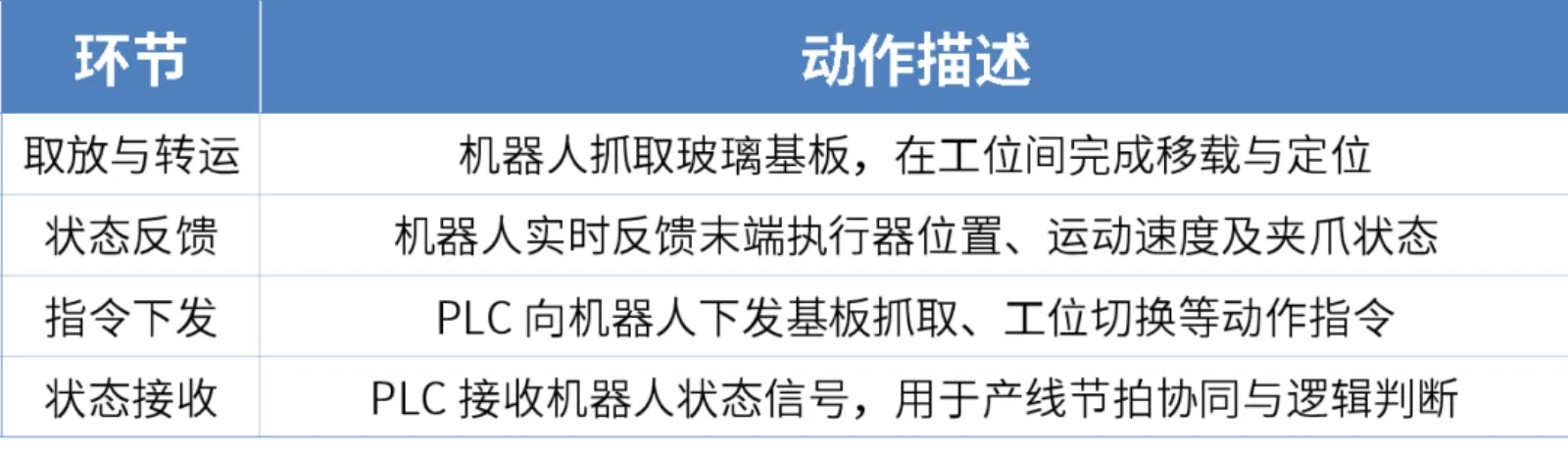
The precision handling section of this production line is collaboratively executed by industrial robots and a PLC control system, responsible for the picking, positioning, and transfer of glass substrates. The robot side needs to provide real-time feedback on end-effector position, motion speed, and gripper status. The PLC side handles production line logic control, issuing action commands to the robot and receiving status signals. The coordinated response of both directly affects handling precision and production line tact time.
II. Solidot Solution
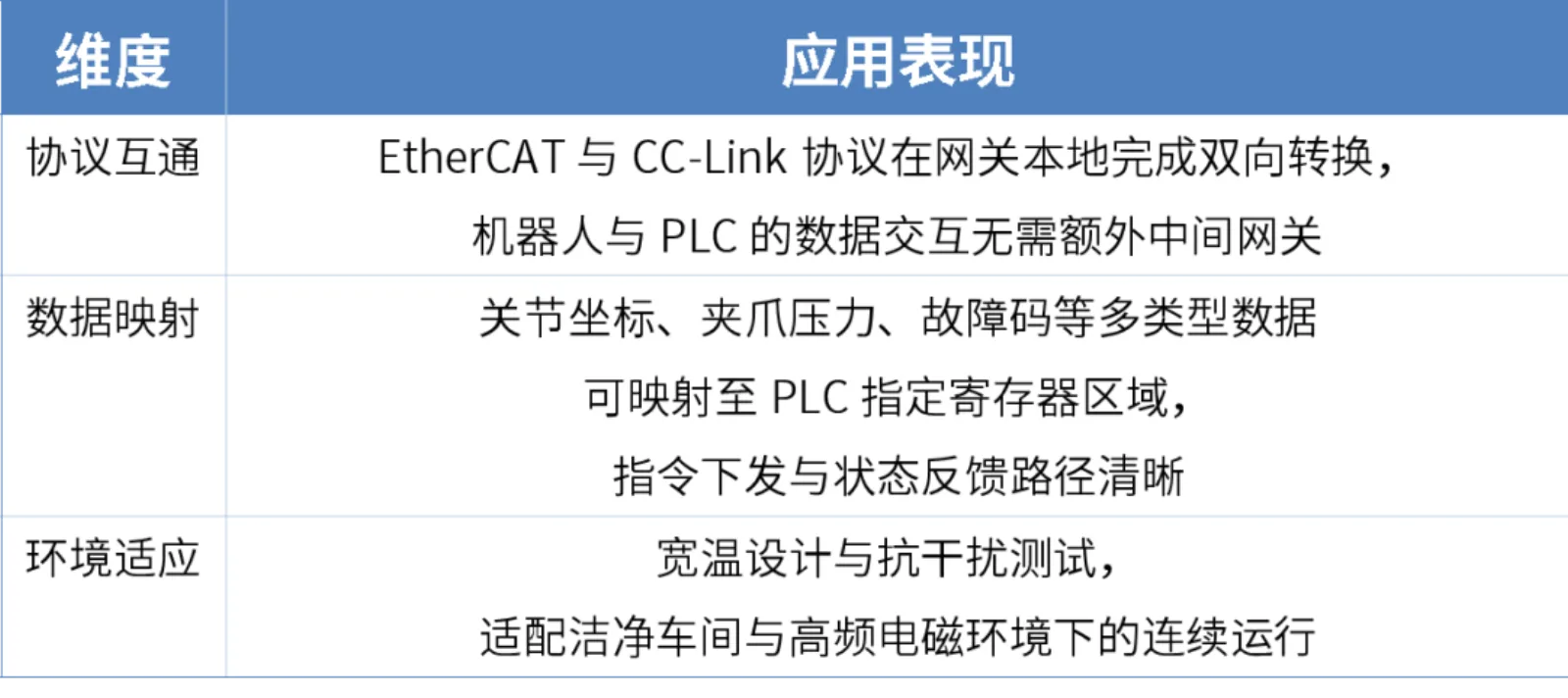
The conversion between heterogeneous bus protocols imposes high requirements on data mapping integrity and forwarding latency: robot joint coordinates, gripper pressure, fault codes, and other data must be accurately mapped to the PLC register area, and action commands issued by the PLC must also be forwarded to the robot in a timely manner. The coordinated response of both directly impacts the positioning accuracy and motion timing of substrate handling.
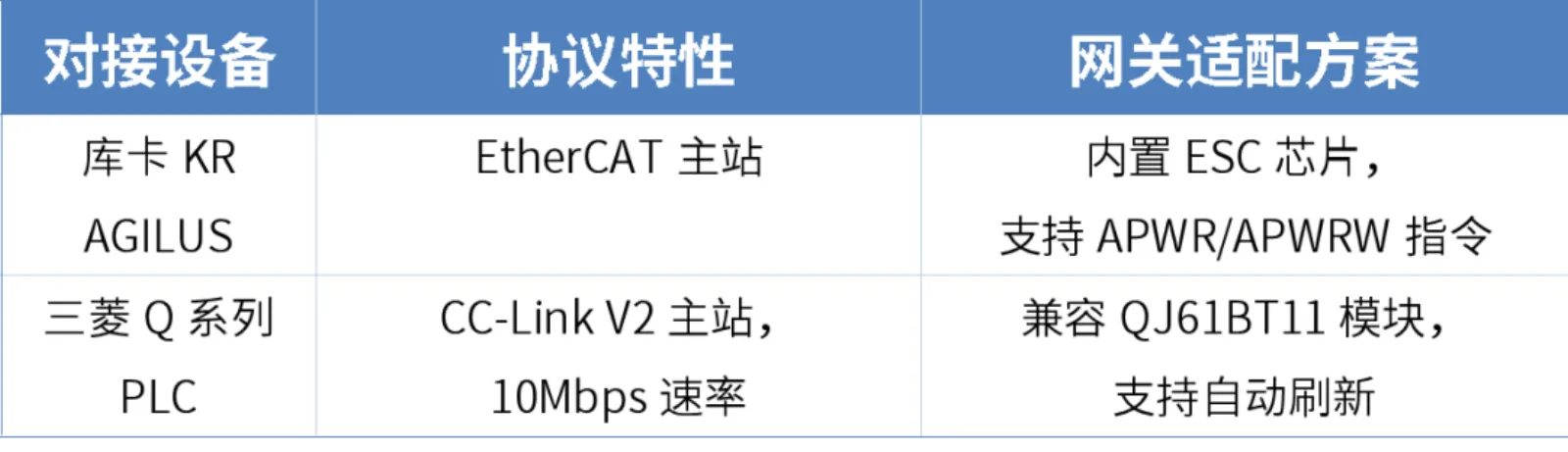
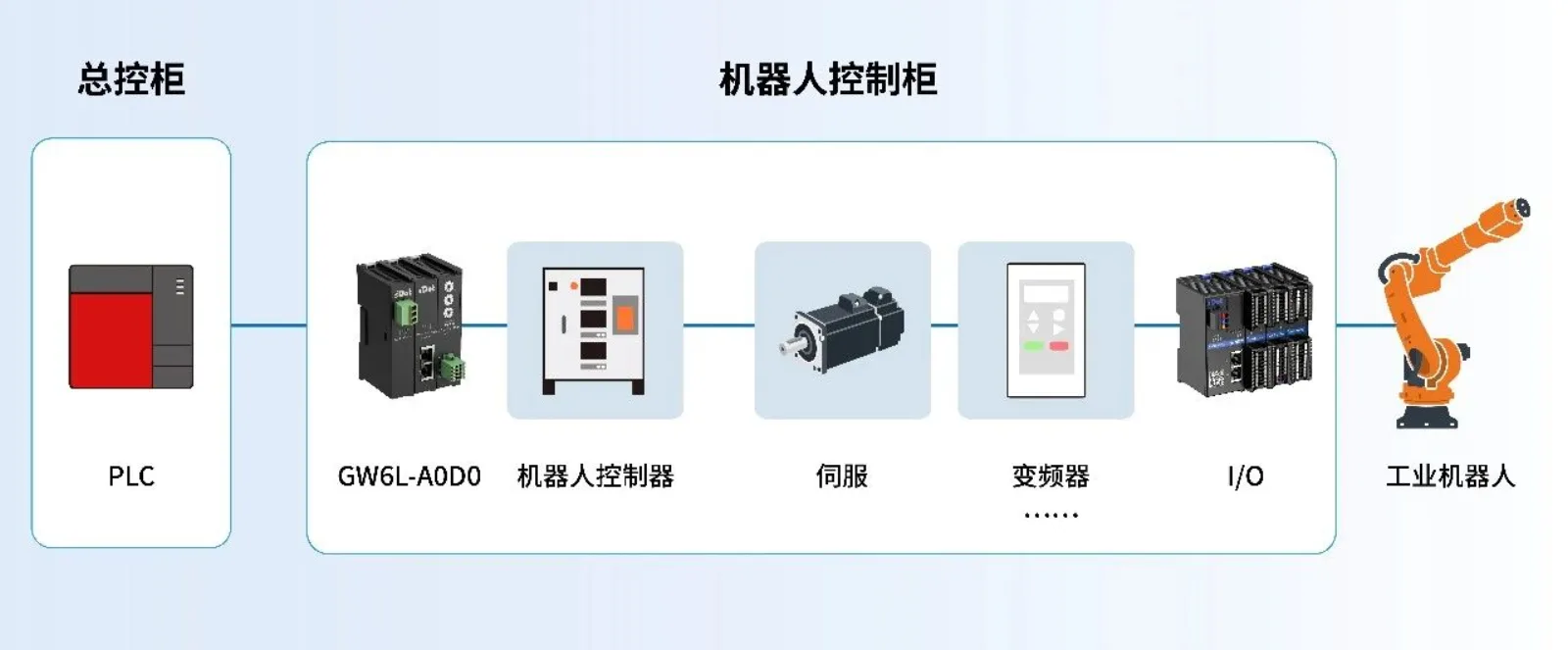
In this solution, the Solidot GW6L-A0D0 is connected to the KUKA robot controller's EtherCAT port via its EtherCAT interface to collect robot joint coordinates, gripper pressure values, fault codes, and other data. Simultaneously, it is connected to the PLC via the CC-Link interface, achieving bidirectional data bridging between the two protocol systems.

III. System Architecture
Control Layer: Mitsubishi Q Series PLC serves as the core controller, responsible for production line logic scheduling, issuing action commands to the robot, and receiving status feedback.
Network Layer: The GW6L-A0D0 gateway is connected to the KUKA robot control unit via the EtherCAT interface and to the PLC master via the CC-Link interface, achieving bridging conversion between EtherCAT and CC-Link protocols.
Field Execution Layer: Robot-collected data such as joint coordinates, gripper pressure, and fault codes are mapped via the gateway to the PLC's RWr (Remote Read Register) area. PLC action commands are issued via the RWw (Remote Write Register) area. The data mapping path is clear and supports bidirectional flow.
IV. Application Results
V. Solidot Slave Protocol Conversion Gateway Module
Solidot's slave protocol conversion gateway module features a slice-type kit design. It currently supports bidirectional conversion between five slave protocols: EtherCAT, PROFINET, Modbus TCP, CC-Link, and EtherNet/IP. With high-speed backplane transmission, protocol conversion latency is within 1ms. The operating temperature ranges from -40°C to +70°C, making it suitable for industrial scenarios such as clean workshops and high-frequency electromagnetic environments that demand high real-time performance and environmental adaptability in protocol conversion.