Application requirements
I/O density, cycle time, motion or process requirements, field distances and maintenance needs are assessed together. This defines the requirements of the working system, not just individual products.
This consumer electronics application uses CC-Link remote I/O to address field control, reliable communication and maintainable commissioning.
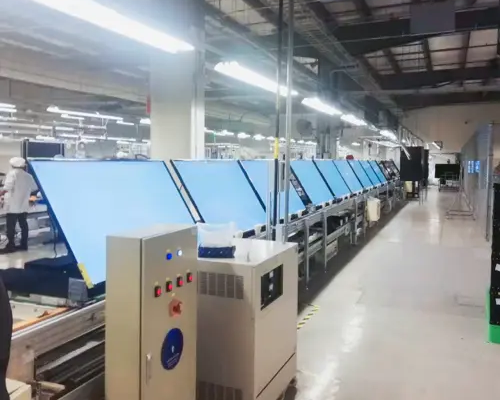
I/O density, cycle time, motion or process requirements, field distances and maintenance needs are assessed together. This defines the requirements of the working system, not just individual products.
The proposed architecture combines CC-Link remote I/O with the machine’s existing control infrastructure and communication protocols. Final product and module selection depends on site requirements.
ProControl can adapt the solution to local project requirements in Türkiye, from site assessment, I/O planning and protocol selection to panel layout, commissioning and after-sales support.
The technical workflow and visual information from the manufacturer are presented below.
With the advent of curved TVs and 8K TVs, our smart home life has become more convenient and dreamlike. Whether it's a spectacular grand concert or an exhilarating goal-scoring moment, every scene and shot is vivid and captured in fine detail. So, how does 8K achieve such an immersive on-site feel?
8K refers to 7680 x 4320 pixels, with a resolution 4 times that of a 4K display and 16 times that of 2K. On a screen of the same size, the more pixels there are, the finer the image presented, which also means that 8K ultra-high definition can restore real images to a great extent, achieving an effect extremely close to what the human eye sees.
The smart production line for 8K TVs is completed by a large number of 'robot + vision' systems, achieving a very high degree of intelligence. In this case, the PLC uses the Mitsubishi Electric Q series, the Master Module is Mitsubishi Electric QJ61BT11N, and the remote I/O uses modules from both Shidian Technology and Mitsubishi that support the CC-Link protocol. Shidian Technology's modules are mainly responsible for collecting and controlling the button signals and Indicator signals of the operation box on the conveyor line, as well as the interaction signals, safety signals, and control cabinet control signals with the robot standalone Device. Meanwhile, the I/O signals of the photoelectric sensors on the belt line and the running signals of the inverter are collected through Mitsubishi Electric's modules. This setup is mainly designed by the customer so that Mitsubishi Electric's remote I/O and the inverter can be unified, facilitating subsequent maintenance.
In addition to demonstrating the 'seamless integration' of Shidian Technology's CC-Link protocol remote I/O modules in this case, in some other solutions, they can also achieve perfect replacement, making them a stable-performing and highly competitive domestic alternative.
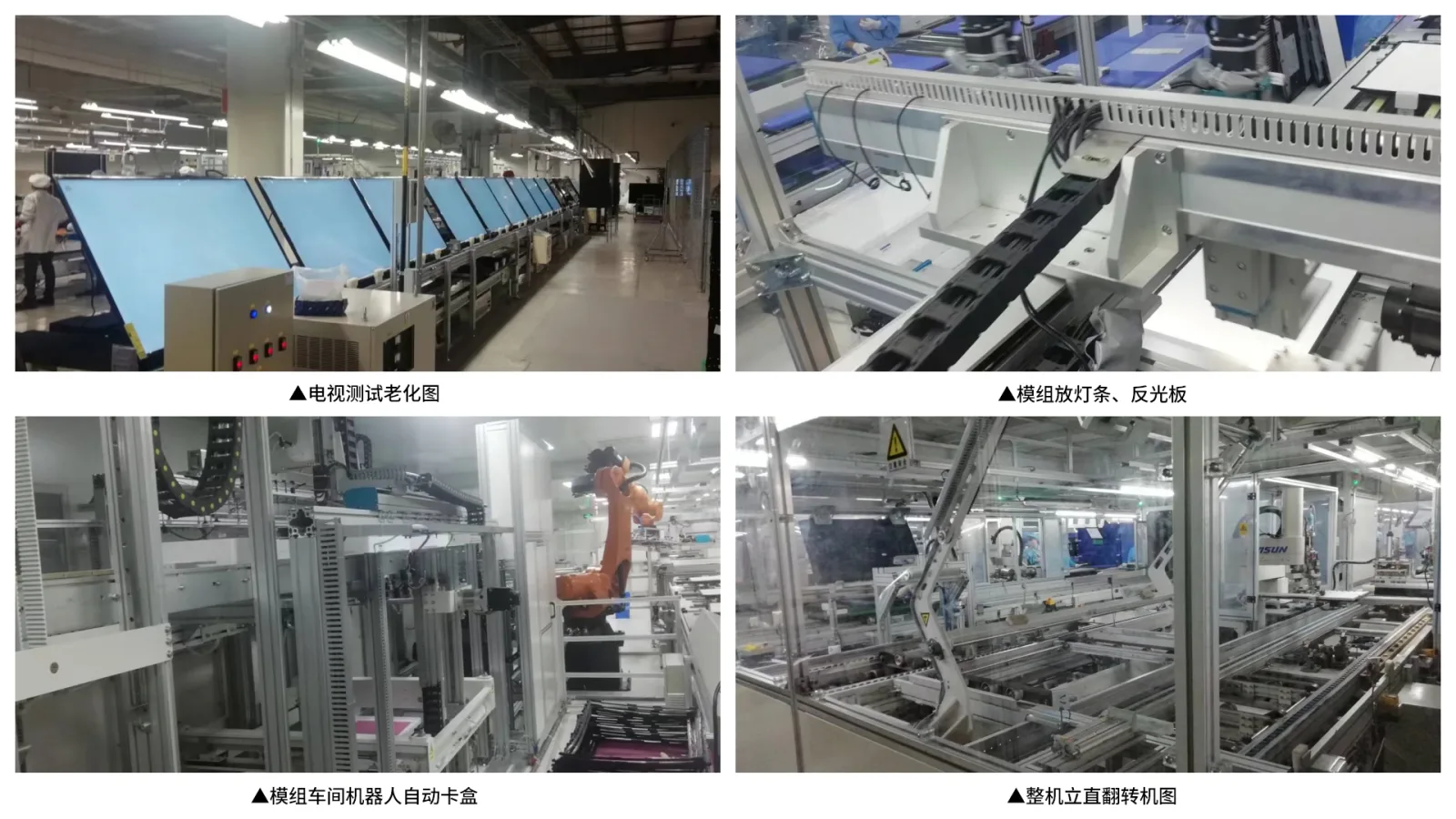
Common production line zones:
(1) Module Area: automatic Backplane loading Device, dispensing machine Device, robot vision AI cassette Device, TV glass and film sorting and unstacking Device
First, the stamped TV Backplane is transported via the conveyor line to the module workshop, where the dispensing machine Device applies adhesive. Workers then manually Install the light bars, Install the light bar wiring, arrange the cables, and Install the light guide plate. The Backplane is then transported via the conveyor line to the robot cassette area for visual photography, where the robot picks up the TV LCD glass after the film has been peeled off by the film peeling machine, receives the position information sent by the vision system, and then loads it into the cassette on the Backplane.
Next, the semi-finished TVs completed in the module area are transported via the conveyor line to the whole machine assembly area. After being flipped by the 180-degree flipping machine, the mainboard, Power Supply board, and other TV accessories are Installed. The product then moves to the robot screw machine station for screw fastening, completing the entire TV assembly in the whole machine workshop.
After being flipped again by the 90-degree flipping machine, the TV is transported to the aging workshop by the upward lift, where it undergoes power-on testing, high-voltage testing, white balance testing, visual logo and factory inspection, and manual inspection. Finally, the TV is laid flat and powered off, then transported to the packaging area by the downward lift.
In the packaging area, the horizontal transfer robotic arm picks up the TV and moves it to the bagging Device. After the TV is bagged, it is flipped and boxed, along with accessories such as the TV remote control. After this, the TV is weighed, sealed, and bottom-folded. The labeling machine applies labels to the TV carton, and finally the product is packed with straps. After sorting by the box combining machine, it is transported to the warehousing area.
Upon arrival at the warehousing area, products are sorted by the code reader according to their codes. Products of the same batch and model are palletized by the palletizing machine, then transported to the film wrapping machine for wrapping. After that, the entire pallet is labeled and transported by AGV to the automated warehouse for storage.
The control systems of these Devices all use Mitsubishi Electric Q series PLCs, while the standalone Devices use Mitsubishi Electric FX5U series PLCs. Since the entire smart 8K TV production line is quite long, the CC-Link protocol is used throughout to connect the entire Network. In addition, since the CC-Link Network supports both 'Y-shaped' and serial wiring layouts, it offers both flexibility and convenience. In the actual field environment, the space in the junction boxes and button boxes is limited. Shidian Technology's CC4-1616A can precisely solve this pain point: its Integrated design offers a clear advantage in small size, while also making Wiring very convenient.
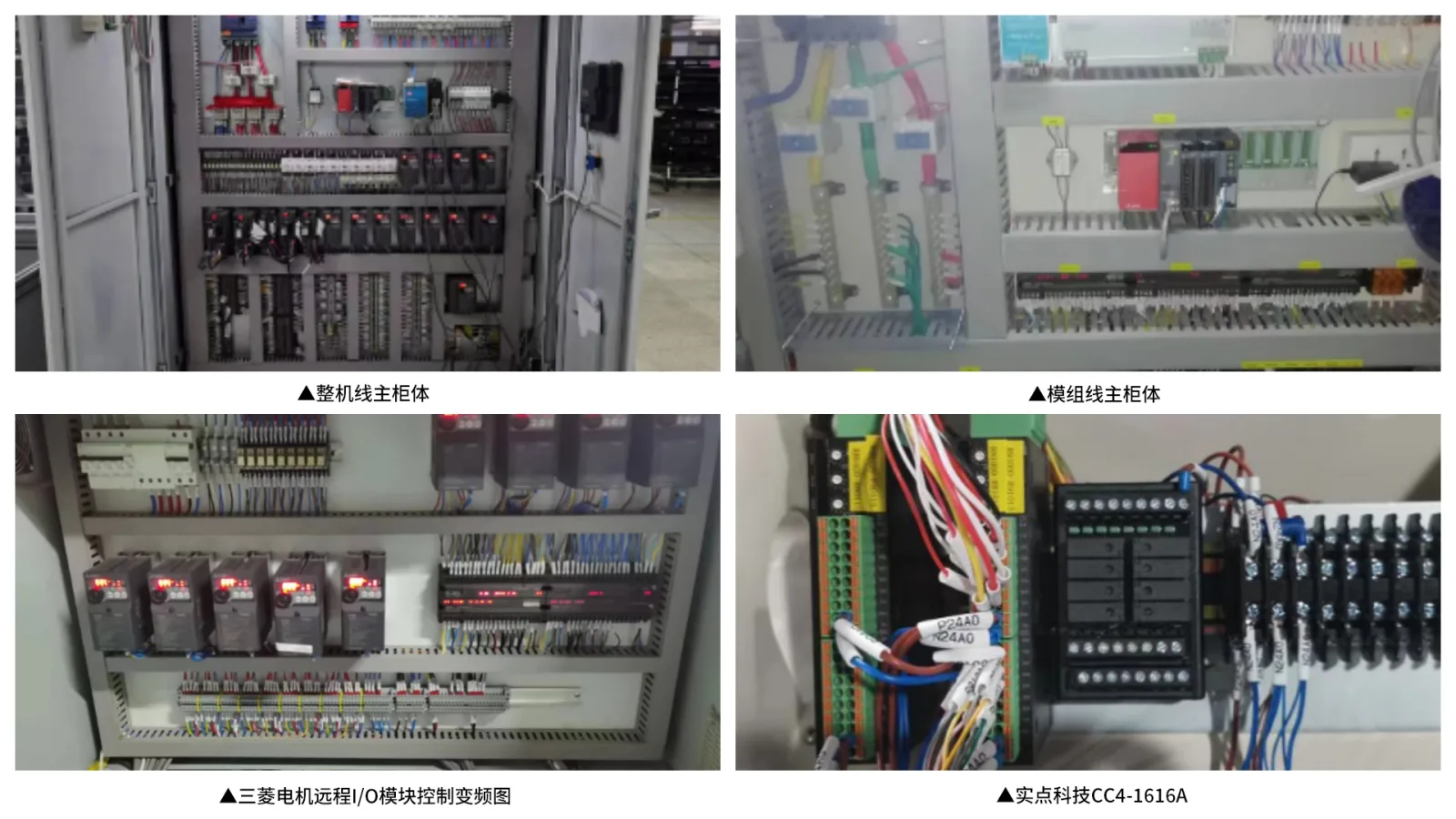
As shown in the figure above, every station along the line is equipped with a button box. The button's Input Signal and Indicator signal are collected by the CC4-1616A module Installed close to the Device. In addition, the interaction signals with the robot station are also collected via the CC4-1616A . Since the robot control cabinet only has a narrow space available for Installation, its compact size makes it the best Use option.
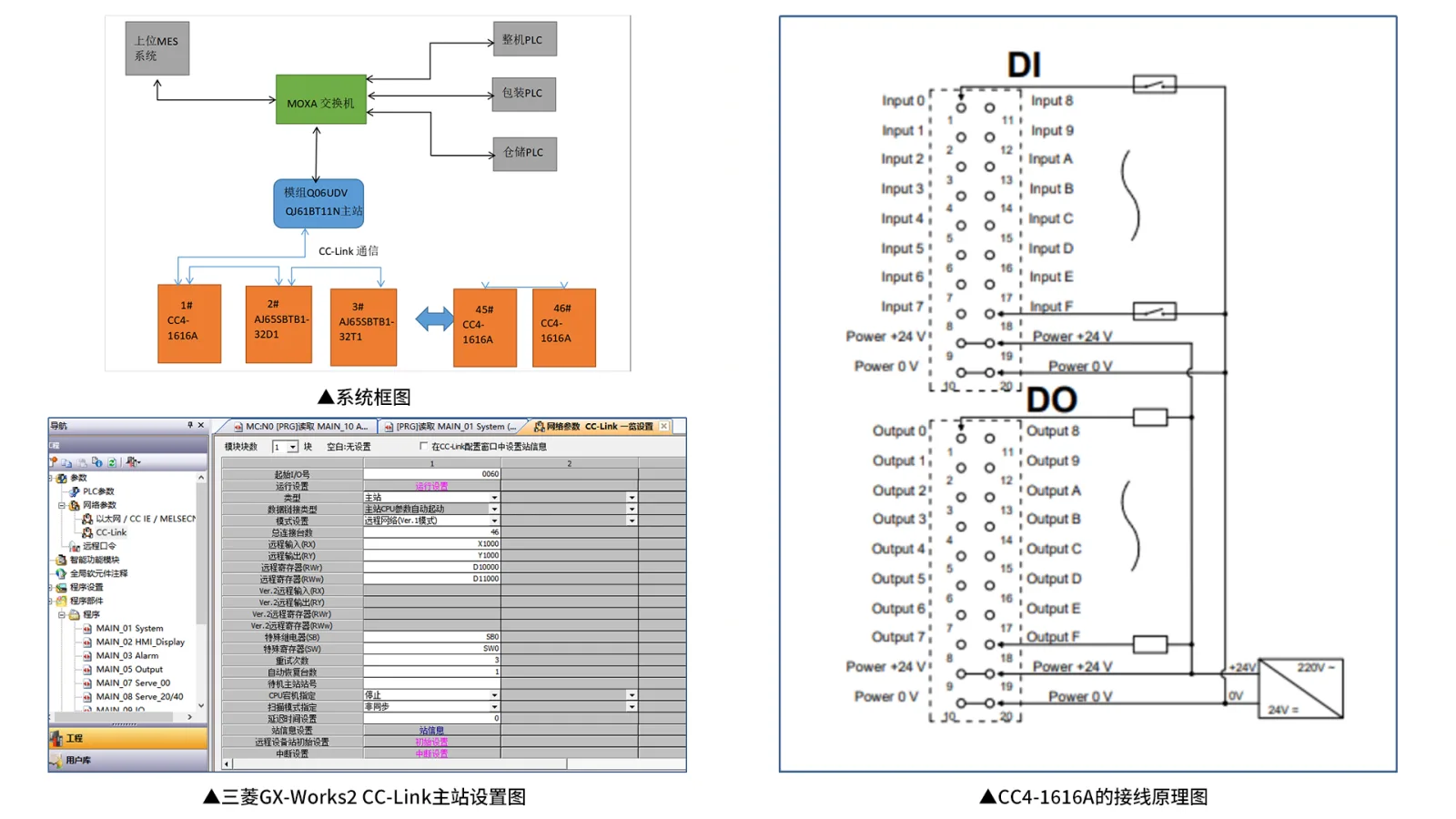
Shidian Technology's CC4-1616A serves as a Remote I/O Station within the Mitsubishi QJ61BT11N master, occupying 1 station, 32 Inputs, and 32 Outputs. Since the on-site cable line is relatively long, the baud rate used is 1. The figure below shows the remote I/O Set in the GX-Works2 software:
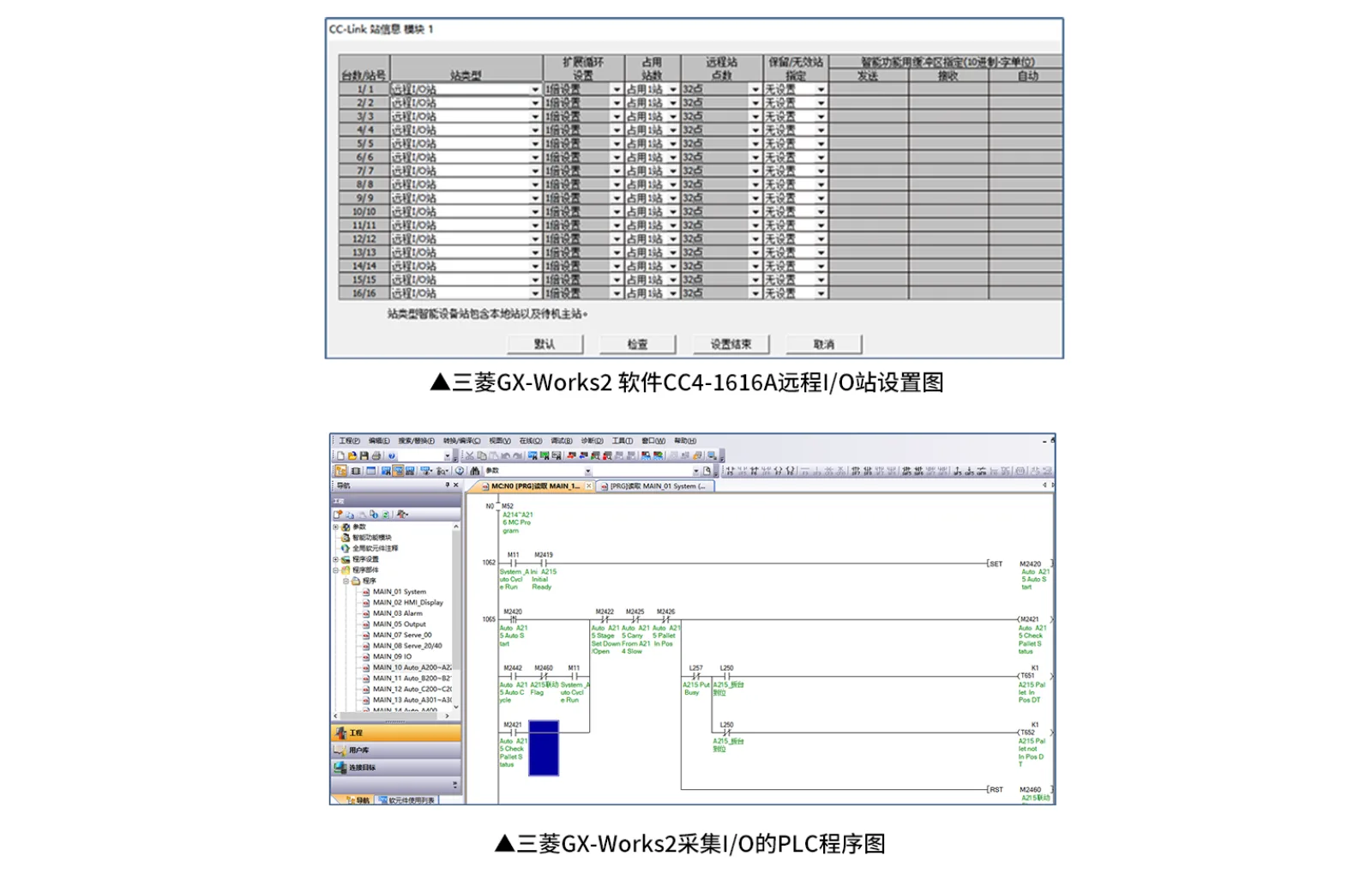
In this case, the overall wiring is simple and flexible, supporting both "Y"-type and string-type topologies, with a wiring length of up to 1200 meters. Combined with the inherent product advantages of Realpoint Technology's Integrated I/O Module CC4-1616A — small size and multiple points — it can be said that mixed use with Mitsubishi Electric's remote I/O achieves a perfect integration, making replacement and maintenance highly convenient.
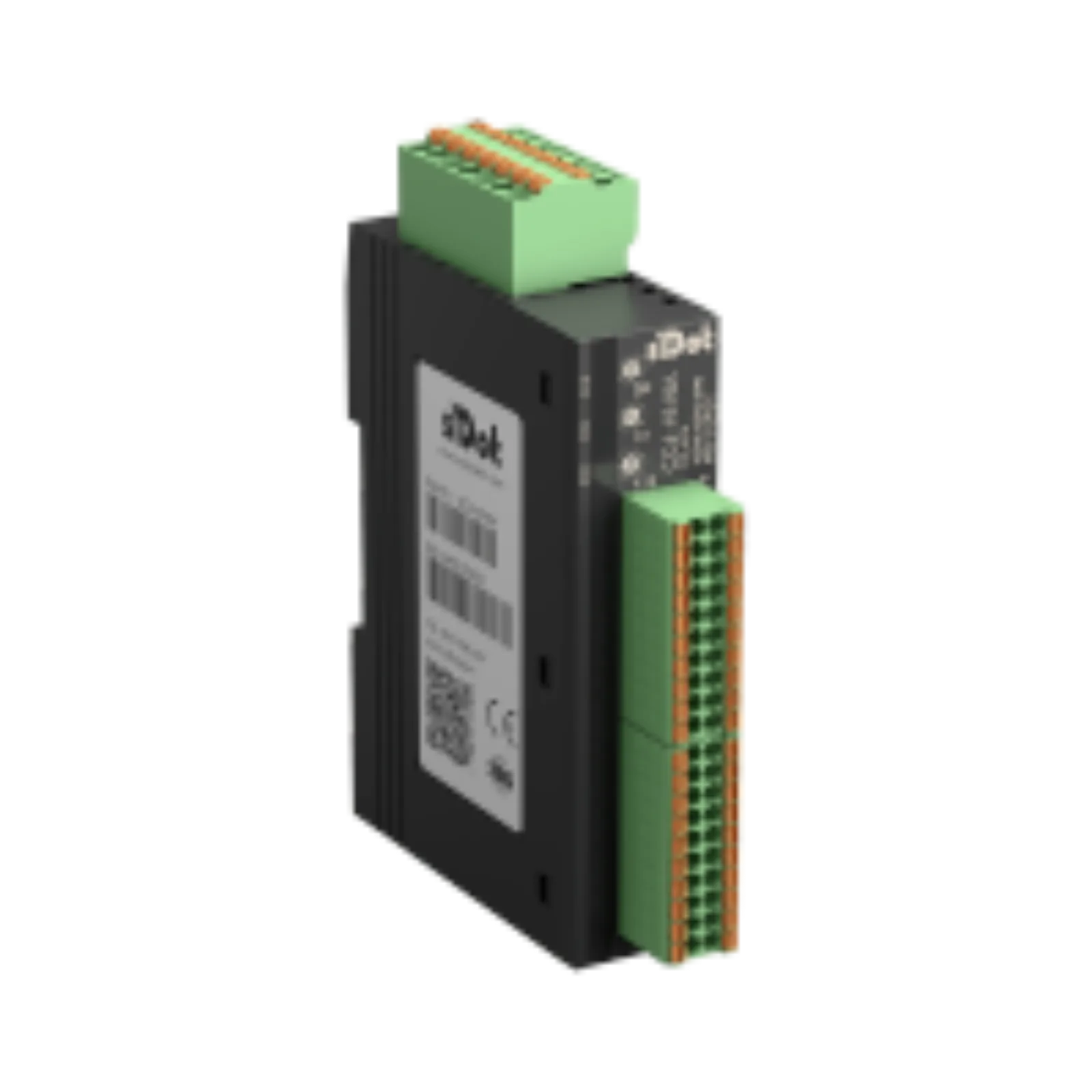
CC-Link integrated I/O, 16 inputs and 16 outputs, NPN, 0.5A, input delay ≤0.2ms