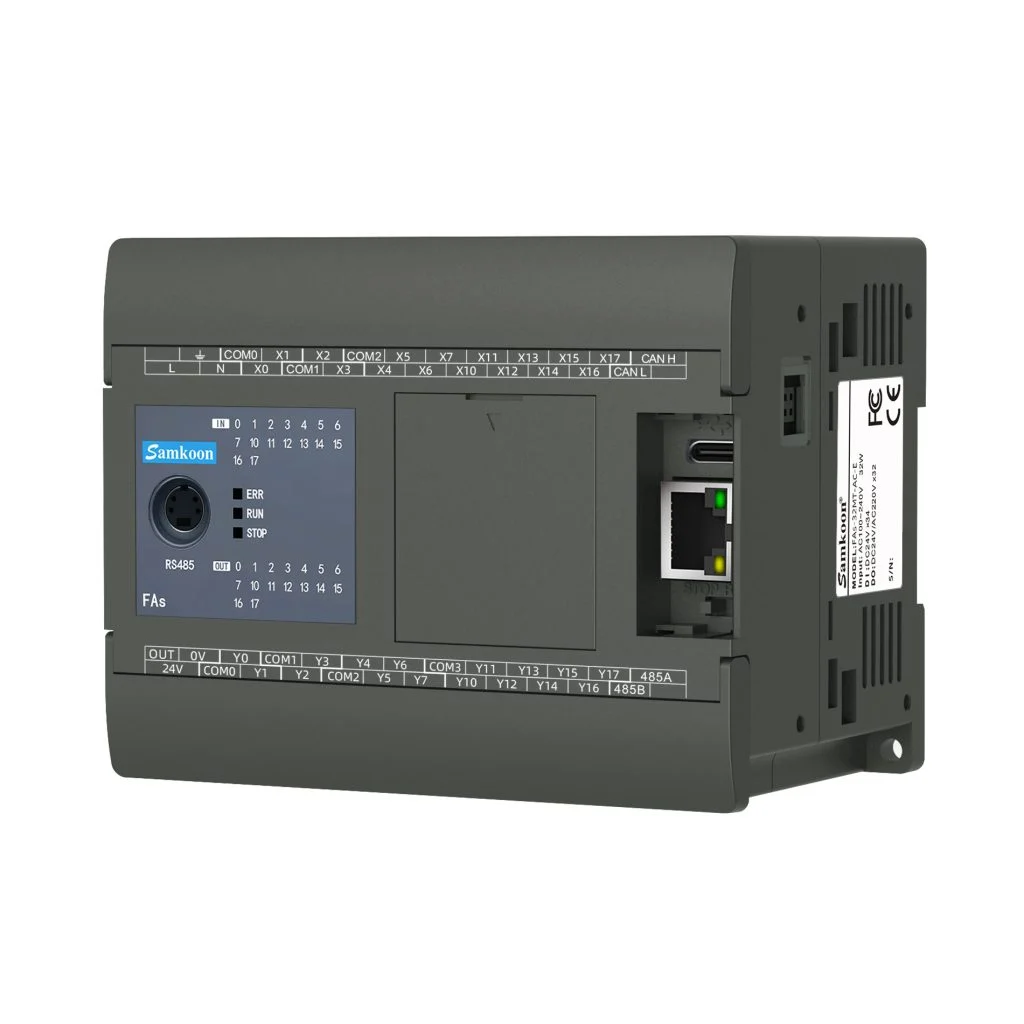
FAS-32MT-AC-E
Candidate in the 16 DI/16 NPN transistor DO, AC-supply, Ethernet Modbus TCP/IP and four 200 kHz pulse-output class.
Open technical pageCompare Delta DVP-ES3 with Samkoon FAs/FGR candidates by I/O, output polarity, Ethernet, motion, expansion and software.
Samkoon FAs can be evaluated in the same selection pool as DVP-ES3 for higher built-in I/O and Ethernet needs, while FGR targets compact duties. No model is recommended before CPU code, supply, relay/transistor and NPN/PNP polarity, motion frequency, Ethernet and expansion architecture are verified.
The exact configuration is selected after engineering review.
Candidate in the 16 DI/16 NPN transistor DO, AC-supply, Ethernet Modbus TCP/IP and four 200 kHz pulse-output class.
Open technical page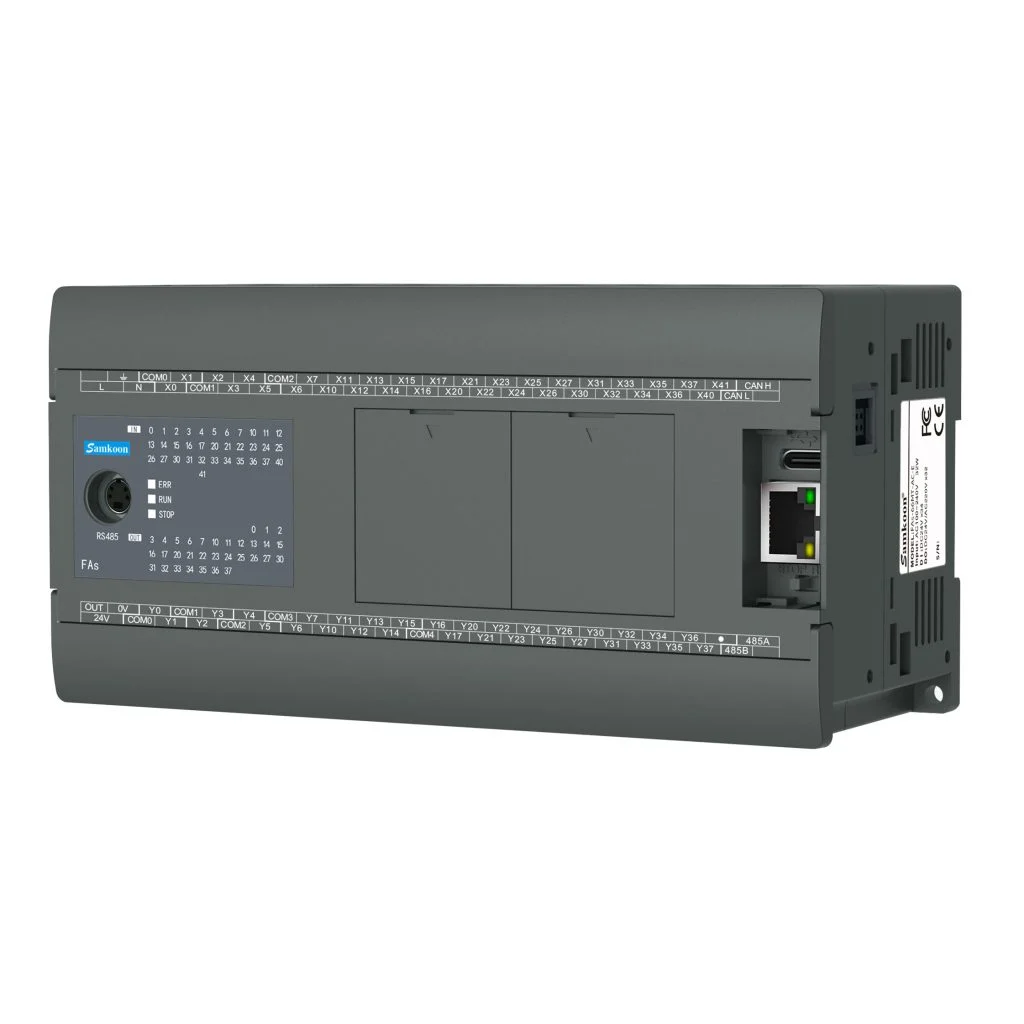
High built-in-I/O candidate in the 34 DI/32 transistor DO, AC-supply and Ethernet class.
Open technical page
Compact candidate in the 8 DI/8 NPN transistor DO and four 200 kHz pulse-output class.
Open technical pageThe table explains product architectures; it is not an exact order-code selection.
| Validation area | Delta DVP-ES3 | Samkoon / ProControl candidate |
|---|---|---|
| CPU and program capacity | DVP-ES3 performance, program/data capacity and CPU functions depend on the exact CPU variant. | FGR and FAs are different CPU/I/O layers; program size, scan time, retained data and instruction scope are measured with the target software. |
| Built-in I/O and polarity | The DVP-ES3 CPU code changes built-in I/O count, relay/transistor output, NPN/PNP type and supply selection. | FAS-32MT and FAS-66MT are NPN-transistor class; FGRB is also NPN-transistor class. SINK/SOURCE input, commons and load current are checked from terminal diagrams. |
| High-speed counters and pulse | DVP-ES3 provides high-speed counting, pulse output and motion functions depending on model/output type. | Official FAS-32/66 and FGRB pages list 200 kHz-class high-speed I/O; channel sharing, interpolation, pulse type and real-load performance are verified by PoC. |
| Ethernet and serial networking | DVP-ES3 uses connections including Ethernet, RS-485 and CANopen according to the exact CPU/module and software configuration. | FAS -E variants are in the Ethernet Modbus TCP/IP and serial Modbus class; FGRB connections are verified per exact model. CANopen parity is not assumed. |
| Expansion and special I/O | DVP-ES3 expansion modules provide analogue, temperature, communications and additional-I/O duties within the family architecture. | FAs can use CAN-based right-side modules and front plug-ins; module count, power budget, analogue resolution and isolation are verified for the exact combination. |
| Software and commissioning | The DVP-ES3 project is developed with ISPSoft/DIAStudio tools, Delta addressing and hardware configuration. | The SamSoar project is rewritten; program, parameters and module settings do not transfer automatically. I/O, motion, networking, retained data and fault scenarios are tested during FAT. |
No. It is not a direct substitute until exact model, electrical, protocol-role, mechanical, software and certification checks pass.
The exact existing code, diagram or I/O list, PLC/network data, supply, environment and special functions in use.
No. The MT label alone does not prove NPN/PNP, common terminals, load current, pulse channels or supply compatibility; the complete electrical diagram is verified.
Official manufacturer sources: Delta DVP-ES3 official product page · Delta DVP official catalogue · Samkoon PLC official family · Samkoon FAS-32MT-AC-E official page · Samkoon FAS-66MT-AC-E official page · Samkoon FGRB-C8X8T official page
This content compares manufacturer-published data under the same project requirement; it does not guarantee direct substitution or project compatibility. ProControl engineering must validate exact model, revision, protocol, electrical, safety and environmental conditions.
Share the exact existing code, I/O list, network and environment so we can identify the right solution without assumptions.