Application requirements
I/O density, cycle time, motion or process requirements, field distances and maintenance needs are assessed together. This defines the requirements of the working system, not just individual products.
This electrical machinery application uses Bus valve terminal and distributed I/O to address field control, reliable communication and maintainable commissioning.

I/O density, cycle time, motion or process requirements, field distances and maintenance needs are assessed together. This defines the requirements of the working system, not just individual products.
The proposed architecture combines Bus valve terminal and distributed I/O with the machine’s existing control infrastructure and communication protocols. Final product and module selection depends on site requirements.
ProControl can adapt the solution to local project requirements in Türkiye, from site assessment, I/O planning and protocol selection to panel layout, commissioning and after-sales support.
The technical workflow and visual information from the manufacturer are presented below.
The aluminum shell motor valve threading and soldering equipment requires completion of processes including workpiece positioning, wire threading, solder curing, and quality inspection. To meet demands for high efficiency, stable soldering, and precise workpiece positioning, the equipment must coordinate multi-axis motion, respond to sensor signals in real time, and control actuators. Adopting Solidot's remote I/O module XB6S series effectively simplifies wiring, enhances communication anti-interference capability, and ensures production stability.
Solidot Products Used in This Case:
XB6S-PN2002
XB6S-3200 , XB6S-0032A
XB6S-PT04A

Automated threading and soldering workflow: Workpiece positioning → Wire threading → Soldering machine → Quality inspection/unloading
【Workpiece Positioning】 The conveyor transports workpieces to designated stations; after detection confirms positioning, clamping mechanisms secure them. 【Wire Threading】 The threading mechanism activates, precisely inserting wires into specified positions on workpieces. 【Soldering Machine】 Automatic soldering is performed according to process requirements. 【Quality Inspection/Unloading】 Conductivity and appearance inspections are conducted; qualified products are removed by the conveyor while production data is recorded.
The system utilizes PROFINET bus protocol with Siemens S7-1500 PLC as the control core. I/O modules (including digital input module XB6S-3200 , digital output module XB6S-0032A , and 4-channel PTO pulse output module XB6S-PT04A ) are connected via coupler XB6S-PN2002 .
The PLC issues commands and collects data uniformly through XB6S-PN2002 :
Pulse output module XB6S-PT04A directly outputs pulse sequences to control stepper/servo motors for positioning and feeding.
Digital input module XB6S-3200 collects product-in-position signals, limit switches, and button status in real time.
Digital output module XB6S-0032A controls conveyor start/stop, gripper cylinder actions, soldering station activation, and status indicators.
The customer’s original solution relied on PLC bus servo drives for positioning, incurring high costs and limited scalability.
After adopting Solidot’s remote I/O XB6S series:
XB6S-PT04A provides pulse control, reducing hardware costs.
XB6S modules offer superior anti-interference, enhancing production efficiency and stability.
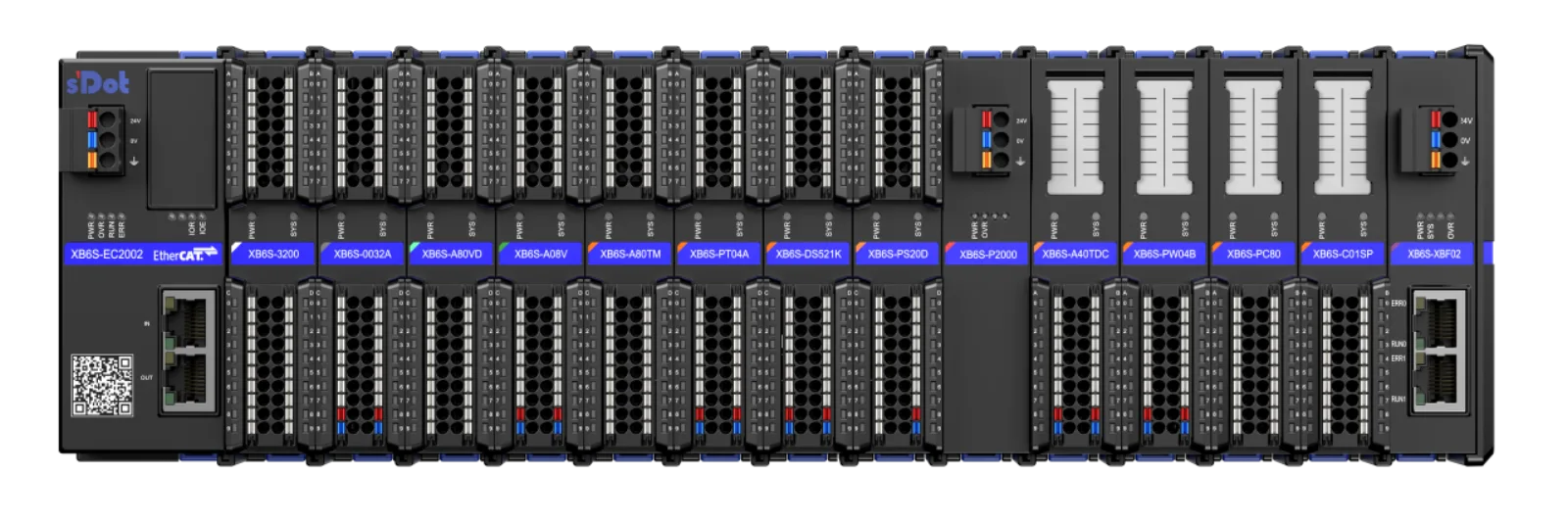
Solidot’s XB6S remote I/O series supports multiple bus protocols and includes motion control/temperature acquisition modules. Key features: