Application requirements
I/O density, cycle time, motion or process requirements, field distances and maintenance needs are assessed together. This defines the requirements of the working system, not just individual products.
This semiconductors application uses XBF distributed I/O to address field control, reliable communication and maintainable commissioning.

I/O density, cycle time, motion or process requirements, field distances and maintenance needs are assessed together. This defines the requirements of the working system, not just individual products.
The proposed architecture combines XBF distributed I/O with the machine’s existing control infrastructure and communication protocols. Final product and module selection depends on site requirements.
ProControl can adapt the solution to local project requirements in Türkiye, from site assessment, I/O planning and protocol selection to panel layout, commissioning and after-sales support.
The technical workflow and visual information from the manufacturer are presented below.
Semiconductor chip inspection demands high precision in signal acquisition, system flexibility, and stability. Solidot's distributed I/O XBF series reduces wiring complexity while enhancing maintainability and scalability, meeting production requirements in complex environments.
Products Used in This Case
XBF4-EC04 , XBF2E-1600 , XBF2E-0016A , XBF2E-0808A
Semiconductor inspection equipment involves: Wafer Loading → Development → Spin Coating → Defect Scanning → Sorting/Unloading.
Based on EtherCAT protocol, the system uses Beckhoff PLCs as the control core. The XBF4-EC04 EtherCAT coupler builds a bus I/O system with:
Signal Handling :
XBF2E-1600 : Photoelectric sensors (wafer positioning), limit switches (arm travel), safety door interlocks.
XBF2E-0808A : Magnetic cylinder switches (motion status), emergency stop signals.
XBF2E-0016A / XBF2E-0808A : Solenoid valves (sorting cylinders, coating valves), servo signals (conveyor control), alarm indicators.
Compared to legacy systems (Beckhoff PLC + local I/O + third-party hubs): ✔️ Cost Reduction : 30% lower cabling/accessory costs; eliminated hub procurement. ✔️ Efficiency Gain : 30% faster installation/maintenance with simplified wiring. ✔️ Enhanced Stability : Fewer nodes improve network reliability.
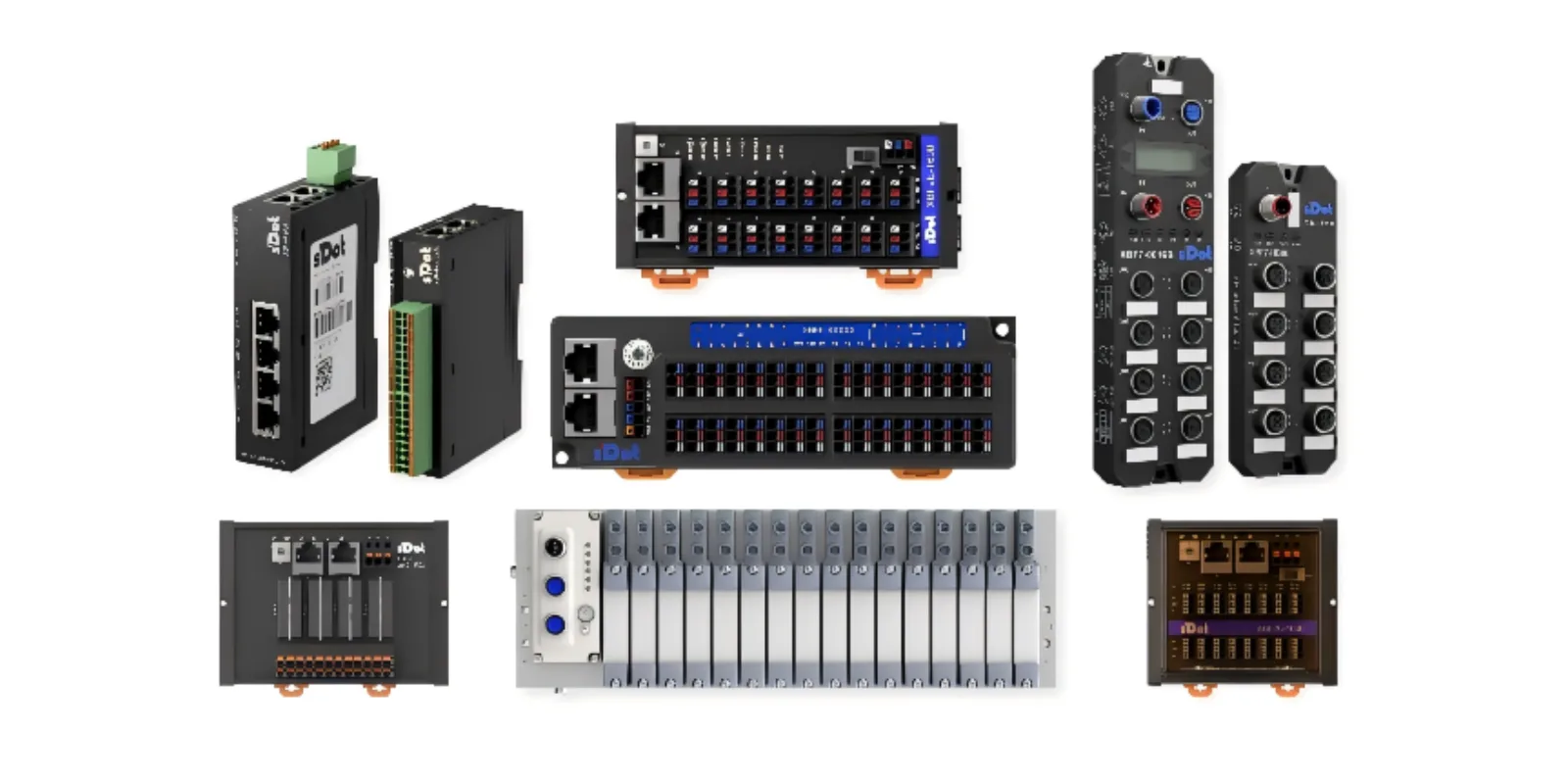
Standard industrial Ethernet cables (no special tools) • Three-wire sensor power supply (eliminates terminal blocks) • Flexible topologies: linear/star/hybrid • Customizable points/structure/special functions