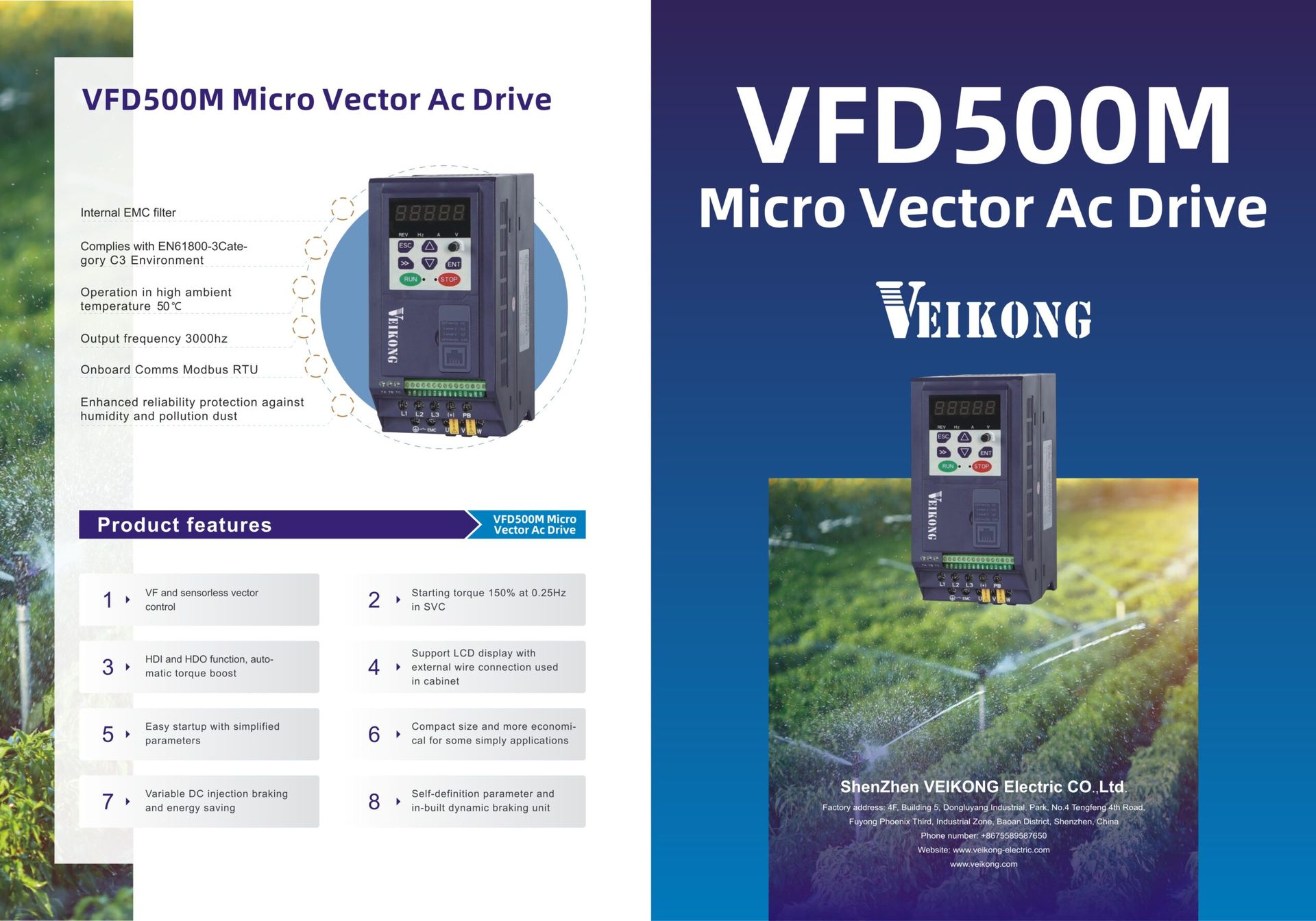
VFD500M
Primary candidate for compact, low-power machine panels; supply class and motor current are matched within the shared model window.
Open technical pageCompare MS300 and VFD500M in small machine panels by supply, motor type, STO, built-in logic, EMC, I/O and temperature conditions.
VFD500M is a technical candidate for small motors in space-constrained panels, but MS300's PM motor, STO, PLC and communication options cannot be treated as equal under one 'compact drive' label. The shared supply and current window must be found first.
The exact configuration is selected after engineering review.
Primary candidate for compact, low-power machine panels; supply class and motor current are matched within the shared model window.
Open technical page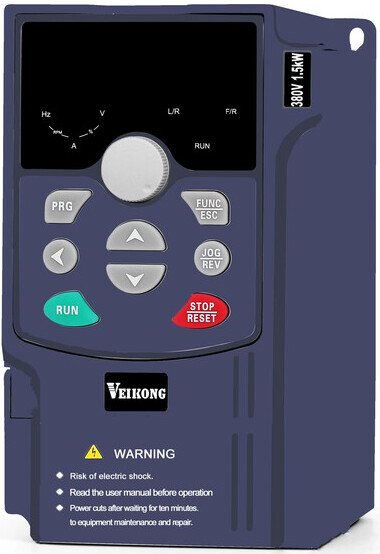
Economical second family for basic speed control; it is considered only after advanced safety, motor and network requirements are checked.
Open technical pageThe table explains product architectures; it is not an exact order-code selection.
| Validation area | Delta MS300 | Veikong / ProControl candidate |
|---|---|---|
| Supply and shared range | MS300 has several single/three-phase voltage and power variants; the exact catalogue row determines selection. | The VFD500M official page publishes 0.4–4 kW at 1-phase 200–240 V and 0.75–7.5 kW at 3-phase 380–480 V; only shared current is compared. |
| Motor technology | Delta publishes MS300 as a compact family supporting IM and PM motor control. | The VFD500M page describes vector and V/f control; compatibility with a specific PM motor is not claimed without evidence from the exact-model manual. |
| Built-in logic | MS300's built-in PLC can execute part of the machine sequence in the drive. | VFD500M basic logic, PID, sleep and process functions are tested against requirements; the Delta PLC program is not transferred. |
| STO and protection | The MS300 family is offered with STO; terminals and certification depend on the exact variant. | If certified STO evidence is unavailable for VFD500M, the safety circuit is rebuilt with an external contactor/motor-isolation architecture. |
| EMC and temperature | For MS300, filter, side-by-side mounting and temperature derating are assessed by selected model. | The VFD500M official page states integrated C3 EMC and 50 °C operation; derating is also calculated from cable length and panel temperature. |
| I/O and commissioning | MS300 uses Delta's parameter structure with USB, communications and I/O resources. | VFD500M's published capacity of 5 DI, 2 AI and 1 AO is mapped to the signal list; scaling and fault-reset tests are run. |
No. It is not a direct substitute until exact model, electrical, protocol-role, mechanical, software and certification checks pass.
The exact existing code, diagram or I/O list, PLC/network data, supply, environment and special functions in use.
No. Commands, timers, I/O and fault logic must be rewritten for the PLC or the documented functions of VFD500M.
Official manufacturer sources: Delta MS300 official product page · Delta MS300 official catalogue · Veikong VFD500M official product page
This content compares manufacturer-published data under the same project requirement; it does not guarantee direct substitution or project compatibility. ProControl engineering must validate exact model, revision, protocol, electrical, safety and environmental conditions.
Share the exact existing code, I/O list, network and environment so we can identify the right solution without assumptions.