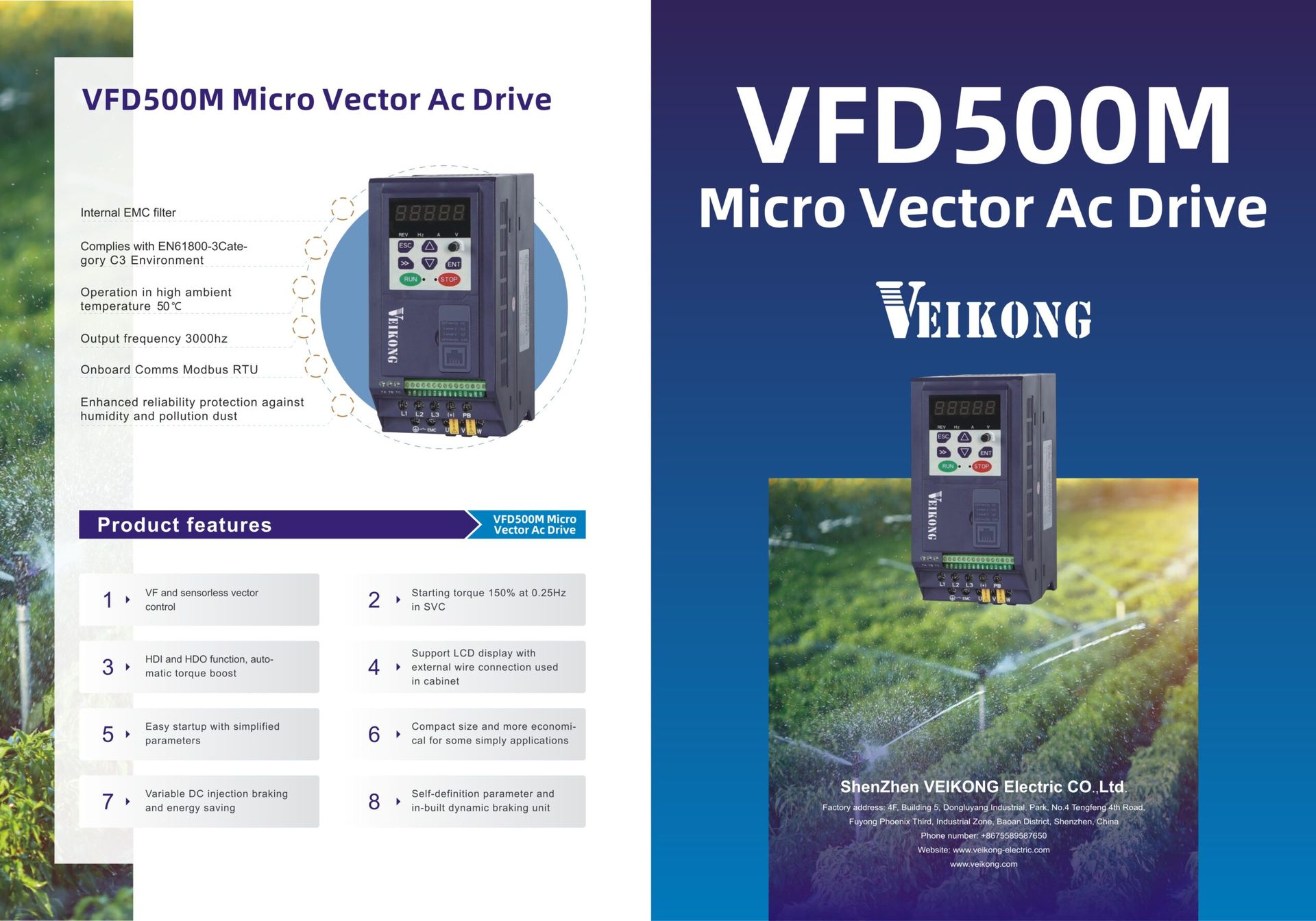
VFD500M
Primary candidate for compact, low-power machine panels; supply class and motor current are matched within the shared model window.
Open technical pageCompare GD20-EU and VFD500M for small pumps, fans and conveyors by shared current, low-speed torque, STO, EMC, braking and Modbus.
VFD500M is a candidate against GD20-EU only within its published supply window around 0.4–7.5 kW. Higher-power GD20-EU models, special STO/EMC variants or existing wiring fall outside this comparison.
The exact configuration is selected after engineering review.
Primary candidate for compact, low-power machine panels; supply class and motor current are matched within the shared model window.
Open technical page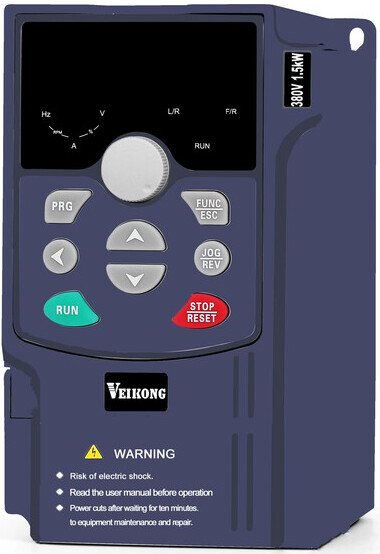
Economical second family for basic speed control; it is considered only after advanced safety, motor and network requirements are checked.
Open technical pageThe table explains product architectures; it is not an exact order-code selection.
| Validation area | INVT GD20-EU | Veikong / ProControl candidate |
|---|---|---|
| Model window | GD20-EU offers compact general-purpose models in 230 V and 400 V classes; the upper power limit is selected from the exact catalogue. | VFD500M is matched only within the official 1-phase 200–240 V 0.4–4 kW and 3-phase 380–480 V 0.75–7.5 kW ranges. |
| Low-speed torque | INVT publishes V/f and sensorless vector with 150% torque at 0.5 Hz for GD20-EU. | VFD500M vector performance is measured with the same motor, carrier frequency and autotune conditions; catalogue percentages are not directly equated. |
| STO | The GD20-EU family is positioned with an STO function; certificate and variant are read from the order code. | If documented certified STO is unavailable on VFD500M, the existing safety circuit is redesigned with external components. |
| Braking | GD20-EU integrated braking unit and resistor selection depend on the model table. | VFD500M braking chopper, resistor ohm/watt value and stopping frequency are calculated from the exact-model manual. |
| EMC and panel | GD20-EU is positioned for European machine panels with C2/C3 filter or variant information. | VFD500M's published integrated C3 filter does not prove suitability for the plant environment and cable length; measurement and grounding design are required. |
| Control connections | GD20-EU uses Modbus RTU, analogue/digital I/O and a keypad workflow. | VFD500M is re-addressed with 5 DI, 2 AI, 1 AO and Modbus RTU; terminal numbers or registers are not retained. |
No. It is not a direct substitute until exact model, electrical, protocol-role, mechanical, software and certification checks pass.
The exact existing code, diagram or I/O list, PLC/network data, supply, environment and special functions in use.
The published VFD500M power/current table must not be exceeded. At higher current, VFD500 or another suitable Veikong family is sized separately.
Official manufacturer sources: INVT GD20-EU official product page · INVT GD20-EU official catalogue · Veikong VFD500M official product page
This content compares manufacturer-published data under the same project requirement; it does not guarantee direct substitution or project compatibility. ProControl engineering must validate exact model, revision, protocol, electrical, safety and environmental conditions.
Share the exact existing code, I/O list, network and environment so we can identify the right solution without assumptions.