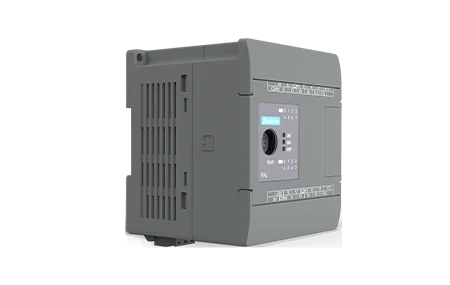
FAS-20MT-DC
Compact candidate in the 12 DI/8 NPN transistor DO, DC-supply and two 200 kHz pulse-output class.
Open technical pageCompare Omron CP2E with Samkoon FAs/FGR candidates by CPU type, I/O, Ethernet/FINS, serial Modbus, pulse, expansion and software.
Samkoon FAs and FGR models can be evaluated for CP2E compact-machine and data-collection use based on I/O, supply and communication requirements. No single Samkoon model is recommended before CP2E E/S/N type, Ethernet/FINS, program capacity and option-board use are verified.
The exact configuration is selected after engineering review.
Compact candidate in the 12 DI/8 NPN transistor DO, DC-supply and two 200 kHz pulse-output class.
Open technical page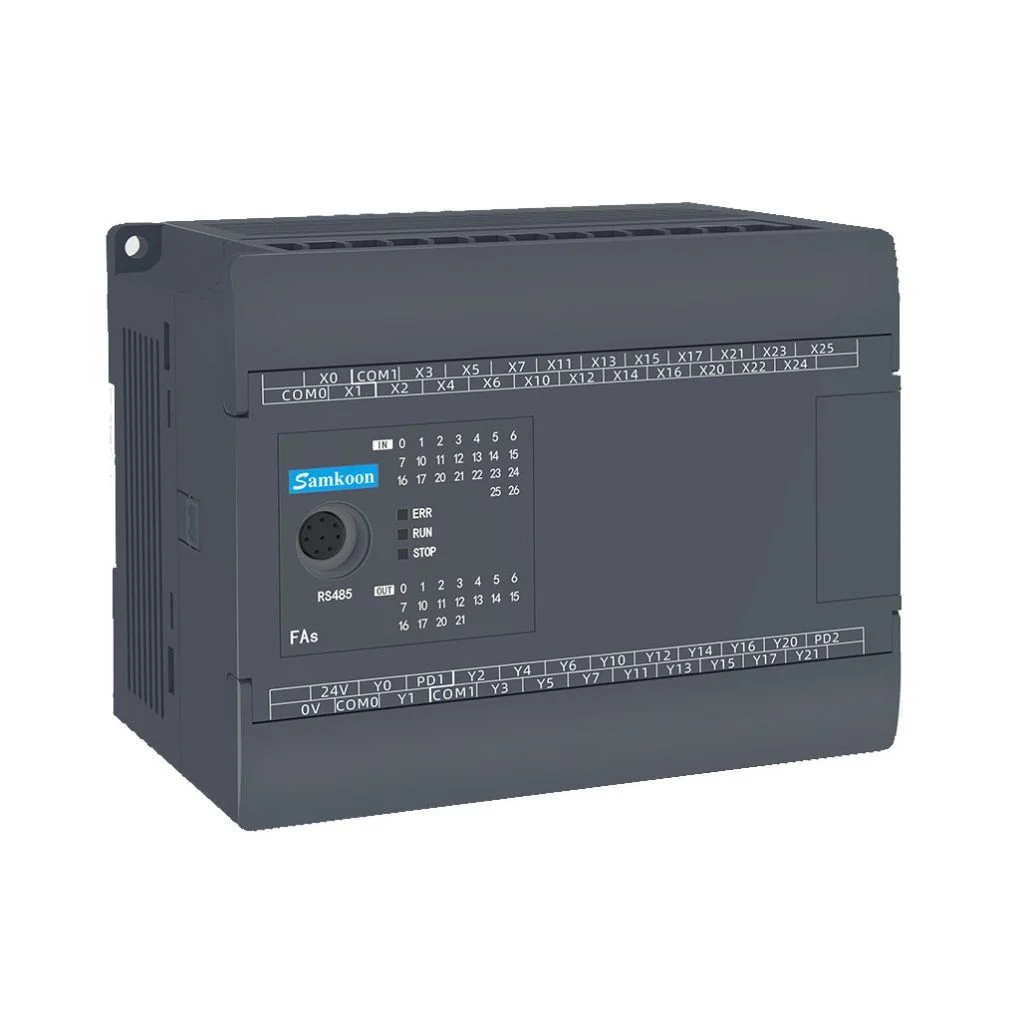
AC-supplied machine-PLC candidate with higher built-in I/O and serial Modbus; exact output count/code is verified.
Open technical page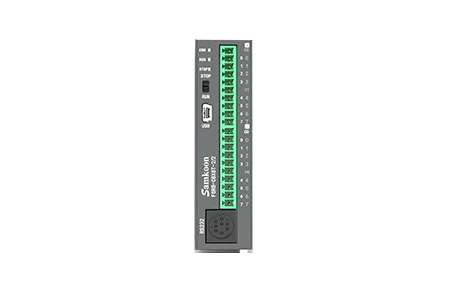
Mini-PLC candidate in the 8 DI/8 NPN transistor DO and four 200 kHz pulse-output class.
Open technical pageThe table explains product architectures; it is not an exact order-code selection.
| Validation area | Omron CP2E | Samkoon / ProControl candidate |
|---|---|---|
| CPU type and program | CP2E E, S and N types change program capacity, communications and option-board scope; 14/20/30/40/60-I/O bodies are not the same CPU. | FAS-20, FAS-40 and FGRB occupy separate I/O/function classes. Program memory, cycle, retained data and instruction scope are measured with the target application. |
| Built-in I/O and supply | The CP2E family offers 14–60 built-in I/O, AC/DC supply and relay/transistor output options; exact electrical design depends on the CPU code. | FAS-20MT-DC is 12 DI/8 NPN DO and DC; FGRB is in the 8/8 NPN and DC class. FAS-40MT-AC uses AC supply; exact I/O and commons are confirmed from the model page. |
| High-speed counters and pulse | CP2E provides high-speed counters, 100 kHz-class pulse and interpolation duties on some CPUs; scope depends on CPU/output type. | Official FAS-20/FAS-40 and FGRB pages list 200 kHz-class pulse/HSC; channel sharing, pulse type, interpolation and real-cycle performance are verified by PoC. |
| Ethernet, FINS and serial | CP2E-N is assessed with built-in Ethernet/FINS and socket functions; E/S types in the context of serial connections and option boards. | Serial Modbus duties on FAS/FGR candidates are selected per exact model; an -E variant is assessed separately when Ethernet is required. FINS support is not claimed without documentation. |
| Expansion and analogue | CP2E grows its duty with expansion I/O, analogue/temperature and communications option boards/modules; maximum scope depends on CPU type. | Samkoon FAs can expand through plug-ins and right-side modules; FGR targets compact duties. Module limit, power budget, resolution and isolation are verified for the exact combination. |
| Software and migration | The CP2E program is developed with CX-Programmer addressing, instruction/function-block structure, settings and FINS/serial communications. | The SamSoar project is rewritten; the CX-Programmer program and FINS configuration do not transfer directly. I/O, pulse, data collection, networking and fault behaviour are accepted during FAT. |
No. It is not a direct substitute until exact model, electrical, protocol-role, mechanical, software and certification checks pass.
The exact existing code, diagram or I/O list, PLC/network data, supply, environment and special functions in use.
No. Ethernet and the application protocol must be verified on the exact Samkoon model; if FINS is unavailable, PLC/HMI/SCADA communications must be redesigned with a supported protocol.
Official manufacturer sources: Omron CP2E official product page · Samkoon PLC official family · Samkoon FAS-20MT-DC official page · Samkoon FAS-40MT-AC official page · Samkoon FGRB-C8X8T official page
This content compares manufacturer-published data under the same project requirement; it does not guarantee direct substitution or project compatibility. ProControl engineering must validate exact model, revision, protocol, electrical, safety and environmental conditions.
Share the exact existing code, I/O list, network and environment so we can identify the right solution without assumptions.